3rd INTERNATIONAL EXTENSION EDUCATION CONGRESS - 2026
Innovating Extension for a Globalized Food System towards Equity and Resilience
Date : December 2-4, 2026
Venue : Kerala Agricultural University, KAU Main Campus, Vellanikkara, Thrissur-680656, Kerala, India




3rd INTERNATIONAL EXTENSION EDUCATION CONGRESS - 2026
Innovating Extension for a Globalized Food System towards Equity and Resilience
December 2-4, 2026
Organizers
Society of Extension Education, India
Kerala Agricultural University, Vellanikkara, Thrissur, Kerala, India
Venue : Kerala Agricultural University, KAU Main Campus, Vellanikkara, Thrissur-680 656, Kerala, India
Innovating extension for a globalized food system is essential to address the complex challenges of food security, climate change, market integration, and social inequality. Agricultural extension traditionally focused on transferring technologies from research institutions to farmers, but globalization has expanded its role to include market linkage, sustainability, and resilience building across crop production, animal husbandry, fisheries, and dairy sectors. In a globalized food system, extension services must evolve beyond traditional knowledge transfer to become dynamic platforms for co-creation. By integrating digital tools, participatory approaches, and localized innovation hubs, extension can empower farmers to adapt global best practices to their unique cultural and ecological contexts. This shift transforms extension into a bridge between global science and local wisdom, ensuring that marginalized communities are not passive recipients but active architects of resilient food futures. With increasing interconnectedness of global food markets, producers must meet quality standards, adapt to changing consumer preferences, and respond to environmental and economic uncertainties. Therefore, extension systems must evolve into more responsive, knowledge-driven, and farmer-centered services. Innovation is a critical driver in this transformation. Advances in digital technologies such as mobile phones, artificial intelligence, remote sensing, and online advisory platforms have revolutionized extension delivery by enabling real-time, location-specific, and cost-effective support. In animal husbandry and dairy, innovative extension promotes precision feeding, improved breeding practices, disease surveillance, and animal welfare management. In fisheries and aquaculture, it supports better water quality management, climate-resilient production systems, and sustainable harvesting practices. Innovation also includes participatory extension approaches, where farmers, fishers, and extension professionals jointly develop and adapt solutions, ensuring that technologies are practical and locally relevant. Market-oriented extension further enhances innovation by integrating producers into value chains, promoting entrepreneurship, and encouraging value addition in a competitive global environment.
Equity is a fundamental pillar of transforming agricultural extension. Despite their central role in food production, smallholders, women, youth, pastoralists, and fishing communities often face limited access to extension services, technologies, and markets. Inclusive extension systems aim to address these disparities by adopting gender-sensitive, youth-focused, and community-based approaches. Equity in food systems requires extension models that dismantle structural barriers to access. Innovative extension can leverage inclusive technologies such as mobile-based advisory services in multiple languages, AI-driven crop diagnostics, and community-led data cooperatives to democratize information. By prioritizing women, smallholders, and indigenous farmers, extension becomes a vehicle for redistributing power and resources, enabling those historically excluded to thrive in global markets while safeguarding their food sovereignty. In livestock and dairy farming, women are deeply involved in daily management but frequently remain excluded from training and decision-making processes. Similarly, small-scale fishers and aquaculture farmers often lack institutional support. Pluralistic extension systems involving public agencies, private sector actors, cooperatives, NGOs, and producer organizations can improve coverage, relevance, and accessibility, ensuring that the benefits of globalization reach marginalized groups. Resilience has become increasingly important in the context of climate change, environmental degradation, and global economic shocks. Resilience demands that extension services embrace systems thinking, linking agriculture to climate adaptation, nutrition, and social justice. Future-ready extension can foster networks where farmers, researchers, policymakers, and consumers collaborate to anticipate shocks and co-design adaptive strategies. For example, climate-smart extension programs can integrate predictive analytics with traditional ecological knowledge to build diversified, sustainable food systems. In doing so, extension evolves into a catalyst for collective resilience, ensuring that globalized food systems remain equitable, adaptable, and just. Extension plays a vital role in building the adaptive capacity of farming and fishing communities by promoting climate-smart and sustainable practices. These include the use of stress-tolerant livestock breeds, improved feed and fodder systems, integrated crop–livestock farming, water-efficient aquaculture, and responsible fisheries management. Extension also supports risk reduction through early warning systems, disease prevention, biosecurity measures, and awareness of insurance and diversification strategies. By strengthening ecological, economic, and social resilience, extension services help ensure the long-term sustainability of food systems.
Finally, innovating extension for a globalized food system requires a shift from top-down, technology-driven models to inclusive, innovative, and resilience-oriented approaches. By embracing digital and participatory innovations, promoting equity and social inclusion, and strengthening the capacity of producers to adapt to climatic and market risks, agricultural extension can play a decisive role in achieving sustainable food systems, improved livelihoods, and global food and nutritional security.
Major Sub-Themes of the Congress :
1. Innovating Extension Education for Global Food Systems
- Curriculum reforms in extension education
- Competency-based and skill-oriented extension training
- Global perspectives in extension pedagogy
- Experiential learning, MOOCs, and digital classrooms
- Internationalization of extension education
- Extension professionals as food system facilitators
2. Digitalization and Smart Technologies in Extension Systems
- ICT, AI, and data-driven extension advisory services
- Digital extension platforms for crops, livestock, and fisheries
- Precision extension using IoT, drones, and sensors
- Mobile-based advisory services for smallholders
- Cyber extension and e-extension models
- Challenges of digital divide and inclusiveness
3. Climate-Smart and Sustainable Extension Approaches
- Climate-smart agriculture (CSA) extension models
- Extension strategies for climate risk mitigation and adaptation
- Resource conservation and regenerative agriculture
- Biodiversity conservation through extension
- Extension for low-carbon and green food systems
4. Reimagining Animal Husbandry Extension in a Global Context
- Livestock extension for sustainable and ethical production
- Extension strategies for animal health, welfare, and biosecurity
- One Health approach in animal husbandry extension
- Digital livestock advisory systems
- Extension for reducing greenhouse gas emissions from livestock
- Capacity building of livestock extension personnel
5. Innovations in Dairy Extension for Competitive Global Markets
- Market-led dairy extension and value addition
- Extension for quality milk production and food safety standards
- Dairy cooperatives and producer organizations
- Precision dairy farming and smart dairy technologies
- Extension strategies for smallholder dairy farmers
- Gender and youth engagement in dairy extension
6. Fisheries and Aquaculture Extension for Blue Food Systems
- Extension for sustainable fisheries and aquaculture
- Climate-resilient aquaculture practices
- Digital tools for fisheries advisory and monitoring
- Extension for value chains, post-harvest management, and exports
- Coastal, inland, and integrated fish farming extension models
- Policy and institutional support for fisheries extension
7. Market-Led and Value Chain-Oriented Extension
- Extension beyond production: processing, branding, and marketing
- Integration of farmers with global value chains
- Extension support for agri-entrepreneurship and startups
- Standards, certifications, and traceability systems
- Export-oriented extension services
8. Inclusive and Participatory Extension Systems
- Gender-responsive extension approaches
- Youth-centric extension for agripreneurship
- Extension for smallholders, pastoralists, and fishers
- Indigenous knowledge integration in extension
- Social capital and community-led extension models
9. Policy, Governance and Institutional Reforms in Extension
- Public–private partnerships (PPP) in extension
- Convergence of extension services across sectors
- Decentralization and pluralistic extension systems
- Role of NGOs, startups, and international agencies
- Financing and sustainability of extension services
10. Global Perspectives and International Cooperation
- Comparative analysis of global extension models
- South–South and North–South cooperation
- Role of FAO, CGIAR, IFAD, and other global institutions
- Extension’s contribution to SDGs and global food security
- Knowledge exchange and international best practices
Boarding and Lodging
Accommodation for the participants will be arranged in nearby hotels/hostel only on their confirmation for the participation in advance. Reservation of accommodation will be made to those delegates who send their registration fee in advance. The cost of lodging must be met by the participants themselves. Alternatively, you can also book accommodation on your initiative.
Note: The delegates should confirm their participation for comfortable arrangements. Registration fee is to be directly deposited in SEE Account through our website on or before September 30, 2026.
|
Registration Fees |
|
|
|
|
|
Delegates |
Rs. 7000/- |
|
Student delegates |
Rs. 3000/- |
|
Retired persons |
Rs. 2000/- |
|
Each accompanying person |
Rs. 2000/- |
|
Foreign delegates |
$ 400/- |
|
Spot registration |
Rs. 8000/- |
|
|
|
|
Dates to Remember |
|
|
Conference Dates |
December. 2-4, 2026 |
|
Submission of abstracts |
October 31, 2026 |
|
Submission of papers |
October 31, 2026 |
|
Application for award |
October 31, 2026 |
Our Achievements
The SEEA is regularly publishing its journal "Indian Research Journal of Extension Education (IRJEE)" and organizing "National Extension Education Congress (NEEC)" and "International Extension Education Congress (IEEC)" in different parts of Country for professional growth of its members and addressing issue pertaining to extension education.


Our Sponsors

Download Brochure
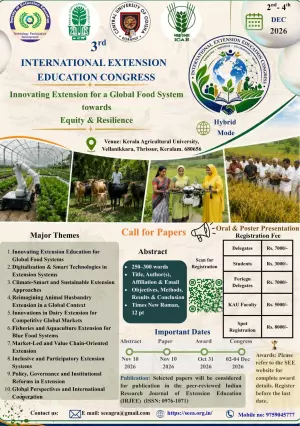
Important Dates
Congress Dates
December 2--4, 2026
Submission of Abstracts
November 10, 2026 (along with registration fee)
Application for Awards
October 31, 2026
Submission of Lead Papers/ Full-length paper
November 10, 2026